January 7, 2006
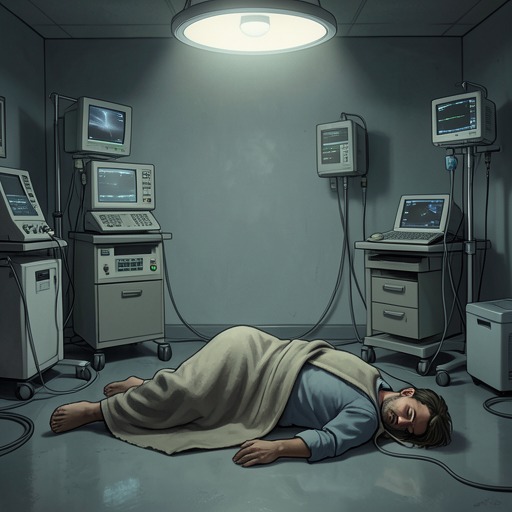
The Time Traveler's WifeJanuary 7, 2006, is the date of the Monroe Street Parking Garage episode, a crisis in which Henry DeTamble’s involuntary time displacement leaves him exposed to lethal cold and leads to the amputation of both feet. The episode makes the familiar costs of his condition suddenly irreversible: his naked arrival, usually followed by concealment or escape, becomes an emergency that Clare and their young daughter Alba must answer, and its aftermath reorganizes Henry’s daily life around a wheelchair and the limits of their home.
Date and Narrative Context
The episode is presented through two accounts of the same night. In Clare’s dated account, she and Henry are asleep when, at 4:32 a.m., the telephone rings. Henry answers and hears his own voice: he is in the Monroe Street Parking Garage, without clothes, in temperatures fifteen degrees below zero, and hopes the car will start. In a separate account dated that same January 7, Henry describes waking in the snow at Grant Park and struggling toward the garage. The paired perspectives let the reader encounter the rescue first as an urgent call received at home and then as the desperate journey that made the call necessary.
This crisis belongs to a longer pattern rather than arriving without warning. Henry has described time displacement as a condition that can leave him naked, without money or identification, and forced to find clothes and hide. It may strike in ordinary circumstances without an obvious trigger; its destinations include crowds, houses, fields, beaches, and other places where his sudden appearance can expose him to danger. The January episode concentrates that recurring vulnerability in Chicago’s winter: being without clothes is no longer chiefly a source of embarrassment or arrest, but a direct threat to his life.
The Call and the Rescue
Clare responds before dawn by pulling on the previous day’s clothes and gathering what Henry will need: a shirt, long underwear, jeans, socks, boots, an extra coat, mittens, and a blanket. She wakes Alba, bundles her into her coat and boots, and follows Henry out to the car. The route is made difficult by six inches of snow, icy ruts on Ainslie, and a car that stalls before Clare can get it moving. Once they reach Lake Shore Drive, however, the roads are empty, and the family speeds through the blue-orange light of the bitterly cold morning toward the garage.
Henry’s account reveals what Clare cannot see from the car. He wakes in Grant Park, with his feet numb, and recognizes the dark Art Institute across the snow. His feet have turned white and stiff; he cannot feel or move them. He staggers, falls, gets up, and continues until walking gives way to crawling. He crosses a street, descends concrete stairs backward while holding the handrail, and crawls to a pay phone. After seven, eight, and nine rings, his own voice answers. Henry asks that voice for help and gives his location near the garage’s guard station.
The call does not end his exposure. Unable to reach anyone at the guard station, he finds the door locked and the window reinforced with wire. Inside he can see a desk, chair, jacket, and space heater, all of them close enough to see but inaccessible. The garage’s ordinary objects—shelter, warmth, a telephone—are present but cannot protect him without help. Clare’s account of the drive and Henry’s account of the crawl converge on that practical dependence: she has to reach him and bring the clothing and warmth his displacement has taken away.
Bodily Consequences
The decisive consequence is frostbite severe enough that Henry loses both feet. The injury carries the danger of the night into the period after the rescue: he cannot simply dress, stand, and resume his former routine. At home, when Kimy comes to get him out of bed, Henry tells her that he cannot get up because he has no feet. She brings his wheelchair, insists that he needs a bath and a shave, and wheels him toward the bathroom, only to find that the doorway is too narrow for the chair to pass. The episode thus makes disability visible not only as an injury to Henry’s body but also as a problem shaped by the spaces through which he must move.
The same change enters family life through practical adjustments and shared activity. The kitchen counters and cabinets are too high for Henry in his wheelchair, so he teaches Clare to cook at the kitchen table, sliding the cutting board and knife toward her as she dices an onion. They make marinara sauce, pesto, lasagna, desserts, poached eggs, salmon, and pizza. When Clare cooks dinner alone for the first time, Henry and Alba encourage her at the table. The scenes do not erase the injury; they show the family developing routines in its presence, with Henry’s instruction and judgment still part of the work even when his wheelchair makes the kitchen difficult to use.
Significance
The episode turns the rules of Henry’s condition into an immediate physical emergency. He arrives without clothing, as he has before, but this time the cold, the distance between Grant Park and the garage, and the locked guard station combine with his inability to feel or move his feet. His familiar vulnerability is therefore both repeated and altered: the displacement is one more instance of a recurring condition, while its bodily consequence permanently changes what he can do afterward.
The two accounts also make the episode a study in unequal knowledge and coordinated care. Clare first hears Henry’s present-day call from beside her in bed; Henry, stranded in the earlier stage of the same crisis, has to call himself from a pay phone. The exchange binds the separated perspectives into a rescue, but it cannot reverse what the exposure has done. The date marks a before and after in Henry’s physical life, while the later details of wheelchair access, cooking, and family routine show that its consequences continue beyond the night in the garage.